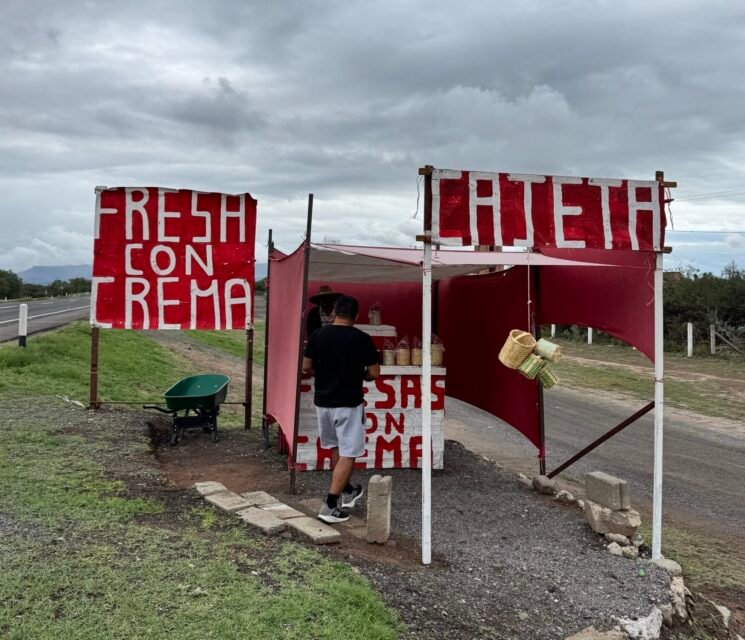
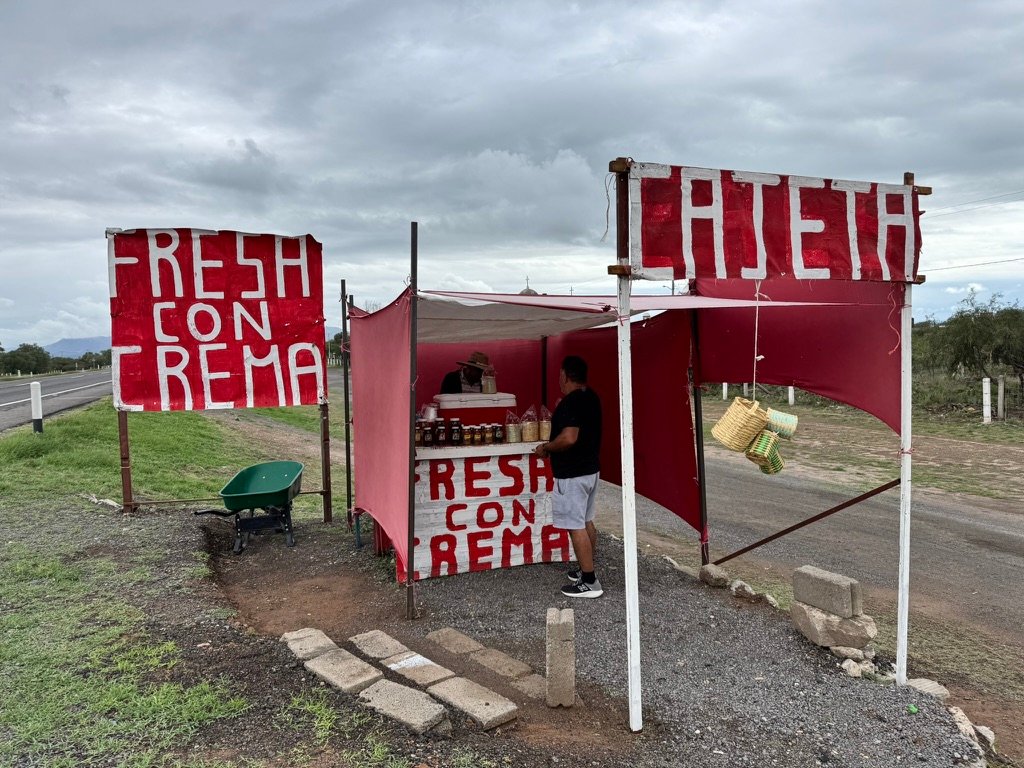
There’s this nice memory I have of my mom bringing a bowl of fresas con crema to the bedroom where I was playing with my Barbies. It was strawberry season, and this dessert was my favorite. I stopped playing and we ate it together.
Some will say that true fresas con crema are made with Lechera, a sweetener that is also thick and creamy. Lechera was not readily available at the time, though, and if it was, the can was too big to warrant its purchase. So, my mom used sugar, and I do too when I make it. But it’s been a long time because I switched over to Greek yogurt, like a healthy person should. Fresas con crema are now a rare treat here at home, but when I do make them, they are, how do you say? Chef’s kiss! And of course, I still use Cacique cream.
Cacique–a word I always found entertaining, like the word esquire. It would come up in the black and white movies my parents watched on channel 22, and in the telenovelas on channel 34. Later, while visiting my husband’s hometown in Mexico, he mentioned some “rich cacique,” who lived who knows where and abused their power.
Cacique seemed to be a word associated with abuse of power. But something inside of me always told me there was more to the story, or word, in this case. I had questions, but never looked for answers. The word came up again recently while researching Mexican Indigenous people who might have benefited from the cochineal industry (which I wrote about in my last UHOM post). It turns out Cacique is indeed more than just a brand. The Google definition for cacique is “a local political boss,” but previously meant “a tribal chief or leader,” and has Taino roots.
When Spanish conquistadores arrived in current-day Cuba, they learned that the Taino referred to their leaders as kasikes. They adopted the word and took it to current-day Mexico. Cacique became the word used to refer to Indigenous leaders, both the existing ones and those established by the Spanish crown. The exact number of caciques that existed in Mexico is unknown. However, there were many, as the Spanish government depended on them to help maintain an organized political structure.
In the 19th century, when New Spain became Mexico, 300 years had passed, and around 60 generations had been born, and with them, a new culture. Cacicazgos had been passed down, sometimes to mestizo leaders, and so the word could no longer be used to refer only to Indigenous leaders. With the revolution, the word cacique became synonymous with dominance or regional political power, more than with Indigenous leadership. But it still means power, which makes sense why a business would choose this word for its company name.
This month, I’m writing about one particular cacique, Cosijopii, who was baptized Don Juan de Cortés. He was in the unique position of being the son of a Zapotec king and a Mexica princess. Additionally, he was in power when the Spaniards arrived. He became the last Zapotec ruler of Zaachila in current-day Oaxaca and is known for his adeptness in straddling two governments: the Zapotec and the Spanish. He became a wealthy man who built the Convent of Santo Domingo in Tehuantepec, which was completed in 1555.
Here is an excerpt from the newsletter– Cochineal and Caciques: A different story of Oaxaca’s past
Cosijopii came to power during the tumultuous period of the Spanish conquest of Mexico. He succeeded his father, Cosijoeza, as cacique (king) of the Zapotecs in the late 1520s 6. This transfer of power coincided with the arrival of Spanish expeditions in Oaxaca. The Spanish conquest of central Mexico in 1521 had sent shockwaves through indigenous realms, and by 1522, Spanish troops pushed southward into Zapotec territory. According to colonial records, on 24 April 1522, the Spaniards led by Captain Pedro de Alvarado – accompanied by the Mercedarian friar Fray Bartolomé de Olmedo – reached Cosijopii’s domain in Tehuantepec 7. Rather than resist, the young Zapotec ruler received them “with open arms” in a gesture of alliance 7. By forming a cooperative stance with the invaders, Cosijopii sought to safeguard his kingdom amid the collapse of indigenous powers around him.
Are you hooked? Read more here! And don’t forget to subscribe to get notified when I post part 2!
In the meantime, I’ll be working on a cacique-inspired zine and artwork to add to the shop, which is now open!!
Perhaps you’re craving a bowl of fresas con crema now, or a plate of enchiladas, covered with Crema Cacique. And maybe, as you’re pouring that delicious cream, you’ll remember that there is history behind the green-lettered word Cacique. Perhaps, too, the creamy white liquid will call you to pull out your Mod Podge and start collaging or some strawberry red work of art.
If it does, or if you do, please share in the comments!
¡Hasta la próxima!